types of boats

Mega Yacht
Privately owned-yacht over 80 feet in length, typically have 5 plus crew, 4 plus staterooms, hot tub, and carry 1 or more tenders.

Yacht/Boat
A yacht is a craft used for pleasure and sport. The name comes from the Dutch word jaght, which translates as ‘hunter’, a fast, light sailing vessel used in the past by the nation’s navy to chase pirates and other ne’er do wells. Yachts are typically 40' to 80' and can actually be any size in length. Typically 2-4 stateroom.
A boat is technically anything under 40ft.

Trawler
A Trawler is a long range yacht that will have 1 and rarely 2 engines, with average speeds of 7-9 kts and typically have a max speed of less than 13 kts. Fuel range is normally 1,500–3,000 miles, with large trawler have 7,000 - 10,000 mile ranges.

Sedan Bridge/Flybridge
Typically 35–65' in length. This is a yacht that has an area on the top of the superstructure that provides 360 views and driving control station as well as seating and lounging space. The lower interior is for staterooms, kitchen, and a salon.
Catamaran/Power Cat
Typically 16'-120' in length, extremely smooth ride with great fuel economy with smaller and lighter engines, which also helps reduce the operating costs. Most cats have 3-4 staterooms and provide twice the beam as a mono-hull boat.
A Power Cat has a similar hull as sailing Cat, but is NOT a sailing vessel. There will be no mast on this boat and the engines have more power than regular sailing cats.
Sailing Catamaran
Typically 30-60' in length, a large sail and can be powered by the sail or two small engines. Provides a extremely stable platform for overnight anchoring.
Convertible Sportfish
Convertible Sportfish is a yacht or boat you can cruise or fish. Most convertible boats have a flybridge you captain from. These boats typically cruise 30 plus kts and mainly used as a fishing boat.
Express/ Open Sportfish
Typically 30-55' in length and have a open cockpit with a salon and cabins below. Mainly used as fishing vessels with and without fishing towers. These boats have been recently replaced with larger center consoles.
Speed Boat
Typically 30-50' in length with speeds of 70 mph to 200 mph. Can be single hull or cat hulls used to race offshore and are often used on large lakes as race and hang out boats.
Center Console
Typically ranging from 20-40' with a few as large as 65'. A center console is simply a boat that has a steering station on a console in the center of the boat, with open deck space or seating in the front. Most center consoles are used for fishing, but are becoming very popular in all forms of boating
Cuddy Cabin
Typically ranging from 30-40'. Same as a center console, but with a forward cabin for storage or sleeping. These vessels are also great for fishing and family outings.
Express Cruiser
Typically ranging from 25-45' with inboard engines These vessels have small cabins and are great family and friend boats that have luxuries of a home and are very versatile.
Sailboat
sailboat or sailing boat is a boat propelled partly or entirely by sails. Almost all sailboats have a single low powered engine and a cabin.
Deck Boat
Typically 15-25' in length. A deck boat is exactly what the name implies, a boat with a lot of deck space, and it derives the name and the space from hull designs that are flared at the top. These boat are for inshore activities.
Wake/Ski Boat
Typically 18-25' in length. Wakeboard Boats are designed to create a large, specially shaped wake, for a wakeboarder to jump the wakes from side to side doing aerial tricks. Great for inshore boating and water sports.
Pontoon/Tritoon
A pontoon is a flat-bottomed boat with two large pontoon tubes underneath the deck, while a tritoon is essentially a pontoon boat with an additional third tube running down the center, providing increased stability and often allowing for higher horsepower engines, making it better suited for rougher water conditions and water sports towing.
Runabout
A runabout is a small to medium-sized powerboat that's used for leisure activities like fishing, watersports, and cruising. They are known for being easy to handle and versatile.
Skiff/Inshore/Bass Boat
A skiff/inshore boat is a shallow, flat-bottomed open boat with sharp bow and square stern, usually under 26ft. A bass boat is the same thing, but with a totally open layout, sometimes including extra seats in the bow for fisherman. These boats very in shape and style and are sometimes used as tenders to larger vessels.
Types of power - drives

Straight Shafts
Straight shafts are the traditional and most common propulsion system. In this setup, a rear-facing engine is connected to a transmission, which drives a shaft that extends straight through the bottom of the boat.

V Drive
V-drives feature forward-facing engines with a transmission that redirects the drive shaft toward the stern. This design positions the engine further back, maximizing interior cabin space.

Pod Drives
Pod Drives
Volvo Penta (IPS Pods with forward-facing propellers), Mercruiser (Zeus Pods with stern-facing propellers), and ZF Marine (ZF Pods) are three major pod propulsion systems. Volvo Penta IPS is the most popular, offering an efficient propulsion solution that enhances handling and performance. These systems feature counter-rotating propellers
Volvo Penta (IPS Pods with forward-facing propellers), Mercruiser (Zeus Pods with stern-facing propellers), and ZF Marine (ZF Pods) are three major pod propulsion systems. Volvo Penta IPS is the most popular, offering an efficient propulsion solution that enhances handling and performance. These systems feature counter-rotating propellers that optimize thrust, while their large gear housings also function as rudders for improved maneuverability.
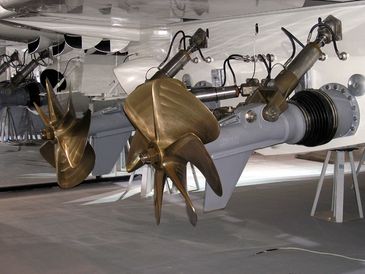
Arneson Drives
These drives are commonly found on race boats and high-performance express yachts like Pershing, Mangusta, and other speed-focused vessels. Known as surface drives, they operate with the top half of the propeller above the water while underway, reducing cavitation and creating an impressive rooster tail effect.

Jet Drives
(basically same as large wave runner jets) - Found on some ski boats and larger Yachts - allows for shallow draft, smooth, and speed - Larger boats like Mangusta and Leopard, smaller boats like Yamaha

Stern - Inboard/Outboard Drives
Stern - Inboard/Outboard Drives
It merges the power of an inboard engine with the versatility of an outboard drive. The engine is positioned just forward of the transom, while the drive unit—often called an outdrive or drive leg—is located outside the hull.

Outboard Engines
An outboard motor is a compact, self-contained unit that includes an engine, gear case, and propeller, mounted on the transom of a boat. It operates 75% cleaner than traditional two-stroke outboards and can generate up to 627 horsepower per engine.
Now, these engines are made in Gas, Diesel, and Electric versions.
Gas Inboard Engines
These boat engines are adapted specifically for marine use. Gasoline inboard engines range from 90 to over 1,000 horsepower per engine and power a variety of vessels, from tow sport boats to large cruisers. In an inboard engine setup, the engine is positioned amidships, with a drive shaft extending through the hull to a propeller, while
These boat engines are adapted specifically for marine use. Gasoline inboard engines range from 90 to over 1,000 horsepower per engine and power a variety of vessels, from tow sport boats to large cruisers. In an inboard engine setup, the engine is positioned amidships, with a drive shaft extending through the hull to a propeller, while a separate rudder controls steering. A transmission is typically used to transfer power from the engine to the propeller, and exhaust is expelled through the stern of the boat.
Diesel Inboard Engines
Diesel Inboard Engines
Diesel engines operate using compression to generate power. While their design includes familiar components like crankshafts, cylinders, and pistons—similar to a traditional gas engine—their fuel systems are entirely different and more complex. These engines vary in size and horsepower and are commonly used worldwide. In the United States
Diesel engines operate using compression to generate power. While their design includes familiar components like crankshafts, cylinders, and pistons—similar to a traditional gas engine—their fuel systems are entirely different and more complex. These engines vary in size and horsepower and are commonly used worldwide. In the United States, however, they are typically found in boats over 35 feet due to their weight, which makes them less practical for smaller vessels. Despite this, diesel engines are favored in larger boats for their ability to produce high torque.
Key Benefits of Diesel Engines:
- Long lifespan
- Operate at lower RPMs than gas engines
- Use non-explosive fuel
Types of Hulls
Planing Hull
This fishing boat has a flat-bottomed or V-shaped front that becomes flatter toward the rear. It is designed to lift the front out of the water as it accelerates, allowing the boat to glide across the surface. At low speeds or when stationary, these boats act like displacement hulls, but as they gain speed, they rise above the water. Most
This fishing boat has a flat-bottomed or V-shaped front that becomes flatter toward the rear. It is designed to lift the front out of the water as it accelerates, allowing the boat to glide across the surface. At low speeds or when stationary, these boats act like displacement hulls, but as they gain speed, they rise above the water. Most small, motorized boats use planing hulls.
Advantages: This hull design is fuel-efficient and allows the boat to reach higher speeds by skimming across the water rather than cutting through it.
Disadvantages: It can result in a rougher, less stable ride, as the boat bounces over waves.

Displacement Hull
This fishing boat features a rounded hull that pushes water aside as it moves. It’s designed to cut through the water with minimal propulsion.
Advantages: This hull design offers a stable, smooth ride by cutting through waves.
Disadvantages: It consumes more fuel to push water aside and operates at slower speeds.

Semi-displalcement Hull
Semi-displalcement Hull
Semi-displacement hulls are typically a blend of planing and displacement hulls. They provide some lift but rely on buoyancy to support the vessel’s weight. This type of hull creates a significant displacement in the water, generating large bow and stern waves.
Types of Hulls
Multi-Hull
Boats that feature a Multi-Chine Hulls, such as catamarans, are very stable on the water but can be more difficult to maneuver, keep in mind that they need a large area for turning.
Round Bottom Hull
Round-bottom hulls function like displacement hulls, gliding smoothly through the water even at low speeds. However, they tend to roll unless equipped with a deep keel or stabilizers.

Deep V Hull
Deep V Hull
Deep V-bottom hulls are the most common type used in powerboats. This design allows boats to navigate rough waters at higher speeds, offering a smoother ride compared to other hull types. However, deep V-bottom hulls require more power to maintain the same speed as flat-bottom hulls.
Types of Hulls
Shallow V Hull
This hull type is commonly seen in flat-bottom planing hulls, typically found on flats boats and deck boats. It’s ideal for shallow water fishing and offers more stability than a flat bottom in light chop.
Round Bottom Hull
Round-bottom hulls function like displacement hulls, gliding smoothly through the water even at low speeds. However, they tend to roll unless equipped with a deep keel or stabilizers.
Deep V Hull
Deep V Hull
Deep V-bottom hulls are the most common type used in powerboats. This design allows boats to navigate rough waters at higher speeds, offering a smoother ride compared to other hull types. However, deep V-bottom hulls require more power to maintain the same speed as flat-bottom hulls.